
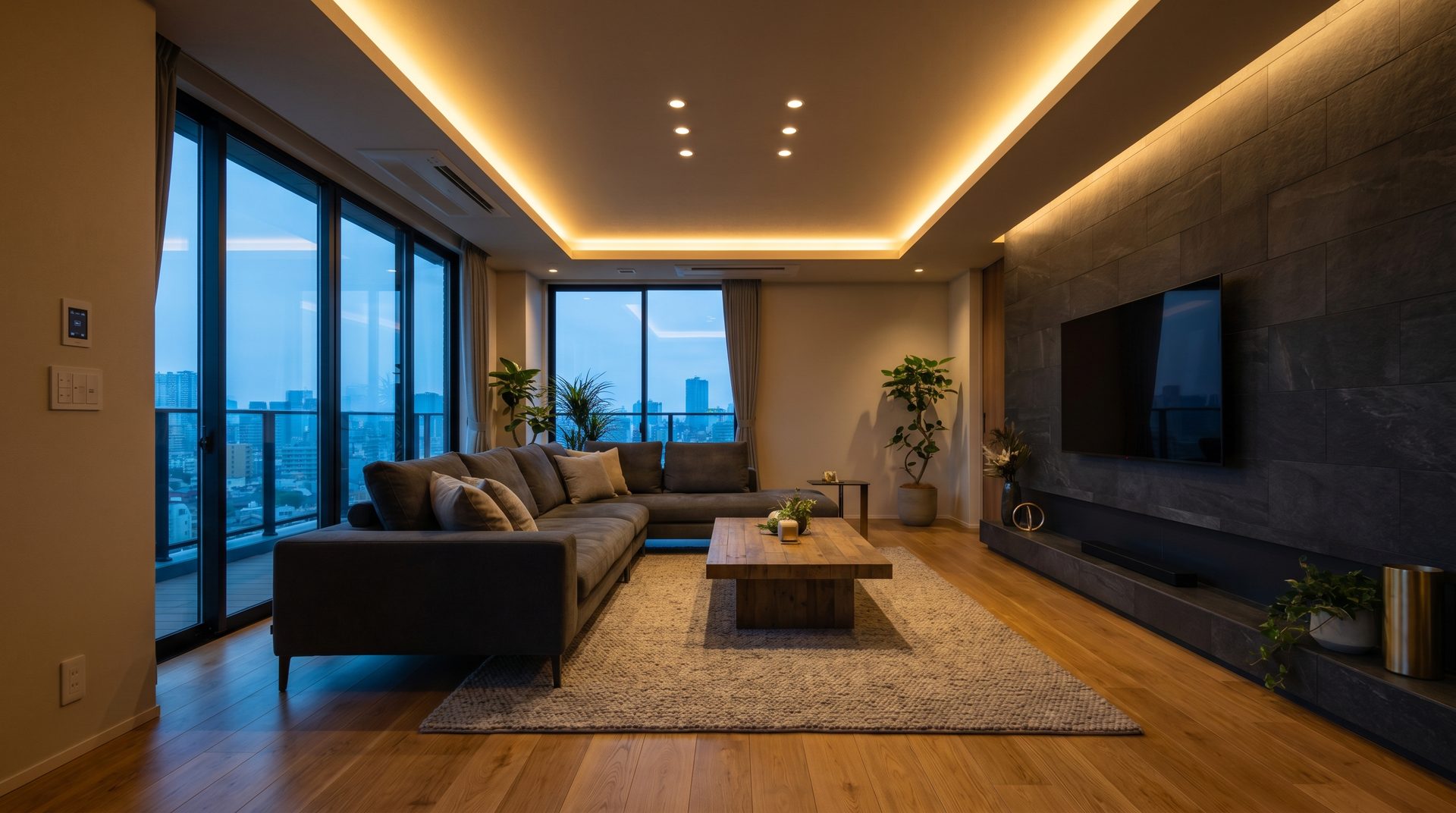
Smart Home Automation in Melaka: The Complete Guide
A smart home in Melaka is a house where lighting, air-conditioning, security, audio-visual and energy run as one system instead of as separate gadgets. This guide covers how that actually works, what decides the cost, what suits a terrace house versus a condominium, and how to judge an installer, based on how Tekovate designs and installs these systems across Melaka and Malaysia.
What is a smart home, and why does it matter now?
A smart home is a house whose subsystems talk to each other. The lights know whether anyone is in the room, the air-conditioning knows whether the curtains are open, the door sensors know whether the house is supposed to be empty, and one instruction can move all of them at once. That is the difference between a smart home and a connected home. A connected home is a drawer full of devices, each with its own app, its own account and its own habits to remember. A smart home is one system with one logic, and the devices are just its hands.
The reason this matters now rather than five years ago is that the industry finally agreed on open standards. Zigbee has been stable for years, and Matter, backed by Google, Apple and Amazon together, means a device bought today from one manufacturer can sit on the same system as a device bought in three years from another. Before these standards, automating a home meant marrying one brand and hoping it survived. That risk has largely gone, which is why Tekovate builds Melaka homes on Zigbee and Matter rather than on any single company's ecosystem.
The part most people get wrong
Most hesitation about home automation comes from picturing it as a luxury toy: voice-controlled bulbs that could just as easily be switched by hand. A properly designed system is closer to infrastructure. It decides how the house behaves when nobody is instructing it, which lights come on when someone walks to the kitchen at 2am, what the air-conditioning does when the last person leaves, and what the house does about a door that opens when everyone is out. The convenience is visible; the design work underneath it is not.
How does home automation actually work?
Home automation has three layers, and understanding them makes every buying decision easier. The bottom layer is devices: switches, sensors, relays, locks, cameras, air-conditioning controllers and motorised curtains. The middle layer is the protocol, the language those devices speak to each other. The top layer is the logic: the scenes, schedules and automations that decide what happens when.
Sensors and triggers do the real work
The devices people notice are the ones they touch, but the devices that make a home feel intelligent are the ones nobody touches. Presence sensors tell the system a room is occupied. Door and window sensors tell it the house has been opened. Light-level sensors tell it the afternoon has turned dark enough for the lights to matter. An automation is just a sentence built from these inputs: when the front door opens after dark and the alarm is armed, turn on the entrance lights and send a notification. Tekovate's design stage is mostly about writing these sentences to match how a specific household actually lives.
What “local control” means, and why it decides everything
A locally controlled system runs its logic inside the house. A cloud-dependent system sends every button press to a server overseas and waits for the answer. The difference shows up the day the internet drops: Most of the system keeps working when the internet drops. Only remote control from outside the house stops until the connection is back. That behaviour is only possible because Zigbee and Matter devices keep talking to each other locally. A house full of cloud-only Wi-Fi gadgets goes quiet in an outage, which in practice means the owner stops trusting it.
Zigbee, Matter or Wi-Fi: which foundation should a Malaysian home use?
The protocol matters more than any single device, because the protocol decides what you are allowed to buy for the next ten years. Tekovate builds mainly on Zigbee and Matter, matched to what each home needs, and the reasoning is worth spelling out.
Zigbee: the workhorse mesh
Zigbee devices form a mesh: every powered device is also a repeater, so the network gets stronger as it grows rather than weaker. It sips power, which is why a Zigbee sensor runs for a year or more on a coin cell, and it does not compete with your laptops and phones for Wi-Fi bandwidth. For a house full of switches and sensors, it is the proven choice.
Matter: the peace treaty between ecosystems
Matter is the newer standard that Google Home, Apple Home and Amazon Alexa all speak. Its promise is simple: a Matter device works regardless of which assistant the household prefers. That is exactly why Tekovate supports all three ecosystems and recommends whichever the family already uses, rather than pushing one. The system underneath does not care.
Where Wi-Fi-only and proprietary systems fall short
Wi-Fi devices usually depend on the manufacturer's cloud, so they stop responding when the internet drops, and dozens of them crowd the same router your family works and streams on. Proprietary systems have a different problem: they work, but only ever with that company's products, at that company's prices, for as long as that company exists. Because Zigbee and Matter are universal protocols, a Tekovate system is not tied to a single vendor, and that is a deliberate design position, not an accident. Tekovate holds no authorised dealership with any manufacturer; hardware is chosen on merit, with Aqara the main choice at present.
Why does a home in Melaka need its own approach?
Most smart-home writing on the internet is written for American or European houses, and it shows. A home in Melaka runs air-conditioning as a way of life rather than a season, sits in humidity that never really leaves, and is more likely to be a terrace house, semi-detached home or condominium than a detached timber house with a basement. Those differences change what automation is worth doing first.
Climate is the clearest example. In a climate where cooling runs most days, automated air-conditioning is not a novelty; it is where comfort and the electricity bill actually live. Zoning rooms so cooling follows people, closing curtains against the afternoon sun before rooms heat up, and shutting everything down properly when the house empties are the automations a Malaysian home feels every single day.
Housing stock matters too. Terrace and semi-detached homes are usually finished, occupied and full of furniture, so the question is not what to build into the walls but what can be added without hacking them. Condominiums add a management layer with its own rules. Tekovate treats condominiums to the same scope as landed property and settles what a building permits during the site visit, which is exactly why the site visit comes before any quotation.
Language and household shape matter too. Melaka homes are often multigenerational, which means the system has to serve a grandmother who will never open an app as faithfully as it serves the person who configured it. Tekovate's answer is unchanged wall switches, automations that need nobody's attention, and voice in whichever assistant the family already speaks to.
What can each part of the home actually do?
Tekovate installs six subsystems, designed as one system. What follows is what each one contributes, and why the order in which homes usually adopt them is not random.
- Intelligent Lighting - scenes, schedules and presence sensing so lights match what a room is being used for. Usually the first subsystem a home adds, because it is the one residents notice every day.
- Climate & Air - automated air-conditioning, ventilation and air quality, zoned room by room. In the Malaysian climate this is where the running-cost story lives.
- Security & Access - door access, cameras and presence-aware arming that follows whether anyone is home, instead of relying on someone remembering to arm it.
- Audio-Visual - multi-room audio and home cinema on the same system as the lights and curtains, so a film night is one command rather than four remotes.
- Energy Management - monitoring and managing household energy so savings are visible on a screen rather than assumed.
- Voice & App Control - one app, plus whichever of Google Home, Apple Home or Alexa the household already uses. The point is fewer interfaces, not more.
The six are designed together even when they are installed in stages. A curtain that closes for the afternoon sun is a climate decision executed by a lighting-adjacent device; an away scene is a security decision that touches every subsystem at once. This is why Tekovate quotes systems rather than gadgets.
What does a complete Tekovate project look like, step by step?
Every Tekovate project in Melaka runs through the same five stages, and two of them are free. Knowing the sequence removes most of the anxiety about engaging an installer.
Stage 1 - Consultation and site visit
It starts with a conversation and then a visit to the property. The visit is not a formality: what the house can take, what the walls hide and what the household actually needs are all site facts, and any number quoted before seeing them would be a guess.
Stage 2 - Design and quotation, free, in 2-3 days
Within two to three days of the visit, Tekovate delivers a design together with a quotation. This stage costs nothing, and you pay only if you accept. The design is the household's automation logic on paper: which rooms, which subsystems, which scenes.
Stage 3 - Wiring and installation, about a week
Installation runs about a week on site with a team of around three people, and day-to-day life in the house is barely disrupted. Because Tekovate sits inside Homes Scope Enterprise, which covers construction, renovation and electrical work, the people planning the circuits and the people installing the smart system answer to the same company.
Stage 4 - Integration, commissioning and handover
Before handover, every control is tested for smooth operation and demonstrated live, and the homeowner is walked through each automation that was set up. The goal is that nothing in the house behaves in a way the owner cannot explain.
Stage 5 - After-sales and the 2-year warranty
Everything is covered by a 2-year warranty with immediate response. Hardware faults are attended on site, with one-for-one replacement depending on the case. After-sales is also where homes usually expand: a room added later joins the same system rather than starting a new one.
How much does a smart home cost in Malaysia?
The honest answer is that the number depends on the house, which is why Tekovate gives it after a free site visit rather than in an advertisement. What can be said in general is what drives the number, and which fees do not exist at all.
What actually decides the number
Three things set the price of any home-automation project: how many rooms are involved, how many subsystems each room gets, and the condition of the site. The same room costs differently in a bare new build and in a finished, furnished house, because one still has open walls and the other does not. This is why Tekovate quotes only after a site visit, and why the visit and the design are free.
The fees that do not exist
No recurring service fee, no annual software fee. The only ongoing costs are optional in-app ones such as cloud storage or additional AI features. There is also no charge for the design stage: the design and quotation arrive in 2-3 days at no cost, and payment starts only when a quotation is accepted. When comparing installers, ask every one of them this same question about recurring fees in writing; the answers vary more than the installation prices do.
Can an existing house be automated without renovation?
Yes, and this surprises more Melaka homeowners than anything else in a first meeting. Tekovate retrofits finished homes without hacking walls, and depending on site conditions and scope, a small job can be completed within a day. Wireless protocols are what make this possible: a Zigbee switch or sensor does not need a new cable chased into the wall to join the system.
For new builds and renovations, earlier involvement simply opens more options. Before wiring, the circuits can be planned around the automation. Before plastering, cabling can still be concealed. After handover, the house is treated as a retrofit. All three entry points work; they differ in how much of the system can be invisible.
Condominiums and apartments get the same scope as landed property. What varies is what each building's management permits, and that is confirmed during the site visit rather than assumed.
There is also no obligation to do everything at once. Planning the whole home first is best, because the design then has a shape for the future to grow into, but starting with a single room and expanding later is fine, and later rooms join the same system.
What do Malaysian homeowners get wrong about smart homes?
Six beliefs come up again and again in Tekovate's conversations across Melaka, and all six are out of date.
- “It stops working when the internet is down.” Not on a properly built system. Local control means switches, sensors and schedules keep running; only remote access from outside the house waits for the connection.
- “You get locked into one brand forever.” Only if the installer builds on a proprietary system. On Zigbee and Matter, the system can be extended with any compliant product.
- “You have to hack the walls.” Retrofits are done without hacking, and a small scope can finish within a day.
- “It only makes sense in a brand-new house.” Before wiring, before plastering and after handover all work; a finished house just has fewer places to hide cable.
- “You must do the whole house at once.” One room is a valid start. The system is designed to be extended.
- “There will be a subscription forever.” Tekovate charges no recurring service fee and no annual software fee; the only ongoing costs are optional in-app ones such as cloud storage or additional AI features.
How do you choose a smart-home installer in Malaysia?
Ask questions whose answers can be checked before signing. The six below decide whether the system still serves you in five years, and every one of them can be answered in a first meeting.
- Which protocol does the system use, and is it an open standard? Open standards are what keep you from being locked to one supplier.
- What still works when the internet is down? A system that goes dark in an outage is a cloud service, not home automation.
- Who does the wiring, and are they part of the same company? Split responsibility is where blame goes when something does not work.
- What is inside the quoted price, and what gets billed later? Ask for the exclusions in writing.
- Are there recurring fees, annual software charges or subscriptions?
- Can it be extended room by room later, and with whose products?
Red flags
A quotation produced before anyone has seen the property. An installer who will not name the protocol. A system that needs the internet to switch a light. A proprietary ecosystem only its seller can ever extend. A price that cannot say what it excludes. Any one of these is a reason to keep looking.
Green flags
A site visit before any number. A written design delivered with the quotation. Open protocols named without hesitation. A clear answer on outage behaviour. A warranty measured in years, with on-site response. One company accountable from the wiring to the app. These are the habits of installers who expect to still be answering your calls in year three.
How long does everything take, from first message to handover?
For a typical whole-home project in Melaka, the calendar looks like this: a site visit arranged around the household's schedule, a design and quotation delivered two to three days later at no charge, about a week of installation once the quotation is accepted, and then commissioning with a live demonstration before handover. A small retrofit compresses dramatically; depending on site conditions and scope, a single-room job can be finished within a day.
What stretches the calendar is rarely the technology. In new builds and renovations, the automation schedule rides on the construction schedule, so a delayed plastering date moves everything behind it; this is normal and planned around rather than fought. In finished homes, the variable is scope decided along the way, because households routinely add rooms once they see the first one working. Tekovate designs for that from the start, so mid-project additions extend the same system instead of reopening the plan.
The stage owners underestimate is the walkthrough at the end. Budgeting an unhurried session for it pays back for years: every scene demonstrated live, every automation explained, every question asked while the installer is still standing in the room. A household that leaves handover able to explain its own house is the actual finish line, and it is why Tekovate treats the demonstration as part of the installation rather than a courtesy after it.
What should a homeowner prepare before the site visit?
Very little paperwork and a lot of honesty about how the household lives. The site visit is Tekovate looking at the property; the conversation around it is the household looking at itself. The most useful preparation is noticing, for a few days, what the family actually does: who gets home first, which rooms sit empty with the air-conditioning running, which lights stay on all night, what the last person out has to remember to switch off. Those observations become automations almost verbatim.
For a condominium, it helps to know roughly what the building management allows, though Tekovate confirms the specifics directly. For a renovation, the renovation timeline matters more than the floor plan, because it decides which of the three entry windows, before wiring, before plastering or after handover, the project lands in. For a finished house, nothing needs preparing at all; the visit itself establishes what the walls will and will not allow.
What never needs preparing is a shopping list. Homeowners sometimes arrive with a basket of devices researched online, and the honest advice is to wait: it is genuinely hard to know which products pair well before the system exists, and buying hardware before design is how drawers fill with gadgets. The design comes first, free, and the hardware follows it.
Why does one company doing the wiring and the automation matter?
Because split responsibility is where smart-home projects go to die. The industry's most common failure is not technical; it is a smart-home vendor blaming the electrician and the electrician blaming the vendor, with the homeowner holding a system that neither will own. Tekovate sits inside Homes Scope Enterprise, the SSM-registered entity that also covers construction, renovation and electrical work, so the people planning the circuits and the people programming the scenes answer to the same name.
The difference is visible at every stage. At design time, the automation plan and the electrical plan are one document instead of two that disagree. During installation, a wiring surprise inside a wall is handled by the team that opened it, not queued for a subcontractor. At commissioning, there is no seam in the system where one company's work ends and another's begins, which means there is also no seam in the warranty. When something needs attention in year two, one phone number owns the answer.
For homeowners comparing installers in Malaysia, this is one of the six checkable questions worth asking anyone: who does the wiring, and are they part of the same company? The answer predicts more about the project experience than any brochure.
Which ecosystem should the house speak: Google Home, Apple Home or Alexa?
Whichever the household already uses. Tekovate supports Google Home, Apple Home and Amazon Alexa, and the recommendation in every Melaka consultation is the same: choose the assistant your family already talks to, because the system underneath does not care. This is a direct benefit of building on Matter, the standard all three ecosystems speak.
The practical differences are smaller than the marketing suggests. A household of iPhones gets the smoothest experience from Apple Home; a household that already owns Google or Alexa speakers keeps them; a mixed household simply picks the one the person who uses it most prefers. What matters for the next decade is not which assistant won the argument but that the devices underneath are not welded to any of them. If an ecosystem falls out of favour in five years, a Tekovate system switches assistants without switching hardware.
Voice is also only one interface among several, and rarely the most used. Wall switches keep working like switches, so guests and grandparents need no briefing. The app carries the detailed controls and the energy view. Automations handle the routine invisibly. A well-designed home is one where voice is a convenience, not a dependency.
What does day-to-day life with a smart home actually look like?
The honest answer is that after two weeks it looks like nothing, because the house has absorbed the routine. The clearest way to describe daily life with a Tekovate system is to walk through the scenes a Melaka family actually uses, which are the same ones demonstrated live at every handover.
An evening scene is the workhorse. Lights settle to a warm level chosen for the family rather than full brightness, the air-conditioning holds the comfort temperature in occupied rooms, and the security side stays aware of the doors while everyone is home. Nobody presses six switches to get there; the house arrives there on its own as the evening starts.
A focus or work scene flips the same rooms the other way: cooler, brighter light for a desk or a study session, and the distractions parked. A cinema scene dims the room, closes the curtains and hands the living room to the film. None of this is exotic hardware; it is the same lights and curtains, orchestrated instead of operated.
The away scene is where owners say the system earns its keep. Leaving the house becomes one action: lighting off, cooling to an economy setting, curtains closed against the afternoon sun, arming active. The reverse happens on return. The energy view then makes the effect visible on a screen, day by day, which is the difference between believing the house is efficient and knowing it is.
How do smart homes handle security and privacy?
A locally controlled system changes the privacy conversation before it starts. Because a Tekovate system runs its logic inside the house, daily behaviour is not a stream of events sent to an overseas server to be processed and sent back. The automations that decide what the lights and air-conditioning do live in the home they serve.
On the security side, the practical questions are about behaviour, not brochures. Arming that follows presence means the house does not depend on someone remembering to arm it on the way out. Door and window sensors report the moment something opens that should not. Cameras and access control sit on the same system as everything else, so a triggered alert can turn on lights as well as send a notification, which is a meaningfully stronger deterrent than a siren alone.
The remaining honest caveat applies to every connected system anywhere: remote access from outside the house, by definition, crosses the internet, and optional cloud features such as storage are exactly that, optional, and charged in-app by the platform rather than by Tekovate. A Malaysian homeowner who wants the system to stay entirely local can have that, at the cost of checking in on the house only from inside it.
What happens after the installers leave?
The week after handover is when a smart home becomes normal life, and the design decisions made earlier show their worth. Because every automation was demonstrated live and walked through at handover, the household starts with a working vocabulary for its own house rather than a manual to study. Because the system runs locally, daily behaviour does not depend on the internet having a good day. And because there are no recurring fees, the relationship with Tekovate after handover is a warranty and a phone number, not an invoice.
Expansion is the other half of after-sales. Households almost always start wanting more automation after living with some: the bedroom wants what the living room has, or the parents' house wants what the children's condo has. On an open protocol, each addition joins the existing system. WhatsApp enquiries reach Tekovate on +60 12-234 9577 and are answered until 22:00, office hours or not.
Smart home questions, answered
Tekovate designs and installs smart-home automation in Melaka. Lighting, climate, security, audio-visual, energy and app control are built as one system rather than as separate devices.
Tekovate is based at No 3, Jalan Eco 2, Ayer Keroh Baru, Ayer Keroh, 75450 Melaka. Jobs are taken across Malaysia, with the current focus on Melaka.
Call or WhatsApp Tekovate in Melaka on +60 12-234 9577. Office hours are 8:00am - 5:00pm, Mon-Fri, and WhatsApp enquiries are answered until 22:00.
Yes. Tekovate visits the property anywhere in Melaka, then provides a design and a quotation within 2-3 days at no charge. You pay only after accepting the quotation.
About one week on site with a team of around three people. A small retrofit in an existing Melaka home can be completed within a day, depending on site conditions.
Yes. A Tekovate system keeps most of its functions when the internet drops, in any Malaysian home. Only remote control from outside the house stops until the connection is back.
Mainly Zigbee and Matter, matched to what each Malaysian home needs. Both are open standards, so a Tekovate system is not locked to a single manufacturer.
Aqara is the hardware Tekovate mainly uses at present. Tekovate holds no authorised dealership with any manufacturer, so the hardware choice is made on merit rather than on a supply agreement.
All three. Tekovate recommends whichever the Malaysian household already uses rather than pushing one ecosystem.
No. Because the system is built on Zigbee and Matter, which are universal protocols, it is not tied to a single vendor. Any Malaysian home on a Tekovate system can be extended with other compliant products.
Yes. Tekovate retrofits existing homes in Melaka without hacking walls, and a small job can be finished within a day depending on site conditions.
Before wiring, before plastering, or after handover all work. Earlier leaves more options open, and Tekovate joins Malaysian new builds at any of the three points.
Yes, to the same scope as landed property in Malaysia. Tekovate confirms what the unit and the building allow during the site visit.
Yes. Tekovate recommends planning the whole home first, but a single room is a valid start. That is how most Melaka homes phase it, and later rooms join the same system.
Tekovate provides a 2-year warranty with immediate response. Hardware faults are attended on site across Melaka and Malaysia, with one-for-one replacement depending on the case.
Tekovate charges no recurring service fee and no annual software fee. On every installation in Malaysia the only ongoing costs are optional in-app ones such as cloud storage or additional AI features.
All of Malaysia, with the current focus on Melaka. Tekovate operates from Ayer Keroh, Melaka.
Tekovate is the smart-home brand of Homes Scope Enterprise, the SSM-registered entity behind it, operating since 2024. The same team covers construction, renovation and electrical work.
Start with a free site visit
We look at the property first, then send a design and a quotation within 2-3 days. No charge for either.
Free design & quote